
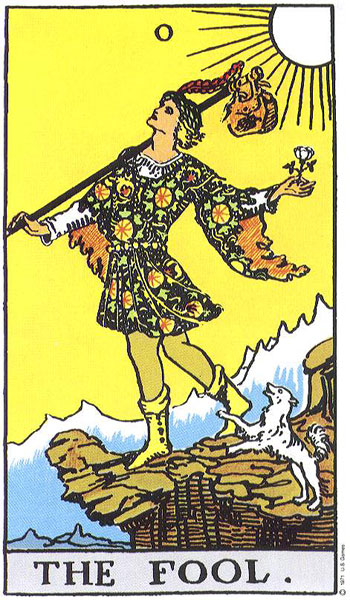
The Fool
Upright Meaning
The Fool upright represents new beginnings, a spirit of adventure, trust in life, freedom, and infinite possibilities. In love, it heralds the start of a brand-new relationship or the infusion of fresh energy and adventure into an existing one. It may signify a romantic encounter, a spontaneous romance, or a willingness to experience emotions with an open and unguarded heart. It encourages following intuition rather than over-planning, but one should be mindful of a potential lack of long-term consideration. In career/academics, the Fool symbolizes a new career direction, entrepreneurship, a job change, or the beginning of a creative project. It encourages taking risks, learning new skills, and exploring with a beginner's mindset. It may represent freelance work, travel-related jobs, or fields requiring innovation and breaking away from convention. The key to success lies in courage and faith, rather than existing resources. In health, the Fool suggests maintaining a positive mindset and vitality, possibly enhancing physical and mental well-being through outdoor activities, travel, or trying new forms of exercise. It embodies a light, free life energy, but one should be cautious of accidents caused by carelessness or risk-taking (such as sprains or falls). Overall, the Fool is a highly positive card, urging you to step out of your comfort zone, trust in the universe's support, and embrace life's journey with innocence and curiosity.
Reversed Meaning
The reversed Fool suggests possible excess, deficiency, or blocked energy. It may indicate recklessness, foolhardy risk-taking, or getting into trouble due to naivety or lack of planning. In love, it can point to hasty commitments, irresponsible behavior, or avoiding relationships due to fear of commitment. It may also signify a relationship lacking direction or a realistic foundation. In career, the reversed Fool warns of potential failure due to impulsive decisions, chaotic career planning, or refusal to take on adult responsibilities. It may manifest as frequent job-hopping without building experience, abandoning projects halfway, or neglecting practical details leading to failure. In health, special attention is needed for accidental injuries caused by carelessness, lack of focus, or avoiding health issues. On the other hand, the reversed Fool can also represent fear of taking risks, being overly cautious and missing opportunities, or having freedom and creativity stifled by worldly constraints. It may show that you are stuck due to excessive worry about risks, or that you long for change inwardly but dare not act. At this point, reassessment is needed: Is it a lack of preparation, or a lack of courage? The card reminds you that the true spirit of the Fool is not foolishness, but choosing to trust and move forward even after fully recognizing the risks.
AI Deep Reading
A fresh reading of this card, written on the spot by AI.
Nothing is written until you ask — the reading is generated only when you tap the button.
History
The Fool is one of the oldest and most central cards in the Tarot, with its imagery traceable back to the Italian card "Il Matto" (The Madman) from the Renaissance period. In early Tarot sequences, the Fool was often numbered as 0 or 22, or even left unnumbered, symbolizing its transcendence of order and detachment from the system. Its archetype blends the figure of the fool from medieval European "Feast of Fools" celebrations—a character who defies social norms, embodying chaos and possibility—with the "innocent traveler" from mythology and literature, such as Perseus or the naive protagonist of fairy tales. In the late 19th-century Rider-Waite Tarot design, Arthur Edward Waite and artist Pamela Colman Smith endowed the Fool with richer symbolic layers, shaping him into a young traveler about to embark on an unknown journey, emphasizing spiritual purity and adventure rather than mere foolishness. Thus, this card becomes both the beginning and the end of the Tarot journey, representing infinite potential and the primordial state of the soul.
Symbolism
The Fool card is rich in symbolism: the young traveler in colorful attire represents the purity and infinite potential of the soul; the white rose in the right hand symbolizes innocence, purity, and new beginnings; the staff (with a bundle hanging from it) carried over the left shoulder represents past experiences and spiritual reserves; the small white dog at the feet symbolizes instinct, loyalty, and warning (or danger); the snowy mountains and cliffs in the background represent unknown challenges and spiritual heights. The most central symbol is the Fool’s posture as he steps forward—he is not unaware of the cliff ahead, but chooses to trust in life and prepares to leap into the unknown. Its number is 0, representing the beginning of all things, emptiness, and infinite possibility; the element of air is associated with the mind, freedom, and new ideas. The overall image conveys a trust that transcends rational calculation, a spirit of embracing adventure, and a journey initiated by intuition and faith.
Advice
Embrace new beginnings, but remain aware. Trust your intuition and the process of life, and bravely take the first step, even if the path ahead is unknown. Allow yourself to explore the world with innocent curiosity, yet be mindful of the "cliff" beneath your feet—bring basic caution and common sense into your adventures. If fear arises, ask yourself: What is the worst that could happen? Can I learn from it? Remember, true freedom comes from conscious choices, not blind impulse.
Related Cards
Frequently Asked Questions
Is the Fool card a "good card" or a "bad card"?
The Fool card is essentially neutral to positive, symbolizing potential and new beginnings. Its "good or bad" depends on the specific context and question. It encourages risk-taking and trust, but if it appears in matters requiring stability and planning, it may suggest the need for added caution.
Does the reversed Fool card always represent a negative meaning?
Not necessarily. A reversed position may indicate blocked adventurous energy, which could be due to excessive recklessness or excessive caution. It needs to be interpreted in conjunction with other cards in the spread and the specific question. The core is to examine why the "new beginning" is delayed or distorted.
How is the connection between the Fool card and the Wind element reflected?
The element of Wind represents intellect, communication, freedom, and new ideas. As a Wind element card, The Fool embodies a free-spirited nature, a mental state that follows inspiration, and the unrestrained, journey-beginning qualities of the wind.