The High Priestess
Upright Meaning
The High Priestess in the upright position represents the awakening of intuition, inner wisdom, and observing without acting. In love, it suggests emotions that are not yet clear or a partnership that requires deep spiritual connection, which may manifest as unrequited love, platonic relationships, or a reminder to understand the other person's unspoken needs through intuition. Singles need to listen to their true inner desires rather than rushing into action. In career, it is suitable for fields requiring insight, such as research, planning, or psychological counseling, and may involve projects that need to be kept confidential or not yet made public. It is advised to accumulate knowledge, trust intuitive judgments, but avoid acting prematurely. In health, pay attention to the endocrine system, sleep quality, and subconscious stress; dreams may convey important bodily signals. Overall, this card encourages cultivating sharp intuition, connecting with deep wisdom through silence and self-reflection, and seeking balance between opposing forces. When facing decisions, answers often lie in the subconscious or require waiting for the right moment to reveal themselves; excessive rational analysis may instead obscure the truth.
Reversed Meaning
The reversed High Priestess suggests blocked intuition, leaked secrets, or excessive suppression. It may manifest as ignoring inner voices in favor of superficial judgments, or being trapped in chaotic emotions unable to clarify true feelings. In love, it may reveal hidden jealousy, indifference, or poor communication, with one party deliberately withholding information. Singles are easily misled by appearances and need to guard against self-deception. In career, confidential information may leak, projects may stall due to insufficient preparation, or excessive isolation may cause missed collaboration opportunities. Health requires attention to hormonal imbalances, insomnia, or mental anxiety, with suppressed emotions potentially manifesting as physical symptoms. The reversal may also point to ignored intuitive warnings—for example, feeling uneasy yet forcing oneself to rationally accept a decision. In some cases, the reversed High Priestess suggests the need to break out of excessive passivity and appropriately express inner knowledge, while distinguishing between intuition and fear projection.
AI Deep Reading
A fresh reading of this card, written on the spot by AI.
Nothing is written until you ask — the reading is generated only when you tap the button.
History
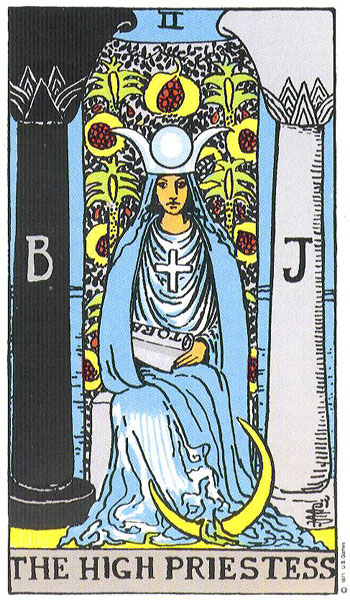
The High Priestess is the second Major Arcana card in the Waite-Smith Tarot system, with its imagery tracing back to medieval mystical traditions. In early Marseille Tarot, this card was often called "La Papesse" (The Female Pope), reportedly inspired by the legendary Pope Joan—a medieval tale of a woman who disguised herself as a male pope, symbolizing hidden feminine wisdom. In the late 19th century, the esoteric order Hermetic Order of the Golden Dawn systematically restructured the Tarot, renaming it "The High Priestess" and imbuing it with richer astrological and Kabbalistic associations. In A.E. Waite's design, the High Priestess sits between black and white pillars, holding a Torah scroll, with a crescent moon at her feet symbolizing intuition and the subconscious. This imagery integrates symbols from Judaism, Christianity, and Egyptian mythology, serving as a bridge between the conscious and subconscious worlds.
Symbolism
The High Priestess sits between the black and white pillars representing duality (Boaz and Jachin), symbolizing the balance of opposing forces; her blue and white robes signify purity and spirituality, and the cross on her chest implies spiritual unity. She wears a triple crown (representing body, mind, and spirit, or the phases of the moon) and holds a scroll marked "TORA" (law/wisdom), which is partially concealed, symbolizing mysteries not yet fully revealed. The crescent moon at her feet represents intuition and the fluctuations of the subconscious, while the pomegranate curtain behind her symbolizes latent potential and abundance, with palm and date palm trees alluding to the Tree of Life. The overall composition emphasizes introspection through a static posture, and the water element echoes her essence of emotion and intuition.
Advice
Practice calming the mind and meditation, and record moments of dreams or intuitive flashes. Before making important decisions, give yourself time alone to listen to your inner voice, but avoid falling into fantasies that are completely detached from reality. For unknown matters, temporarily maintain observation rather than forcibly uncovering the answers. If you feel confused, try to communicate with your subconscious through art, writing, or symbolic analysis (such as dream interpretation).
Related Cards
Frequently Asked Questions
The High Priestess and the Hermit both represent introspection. What is the difference?
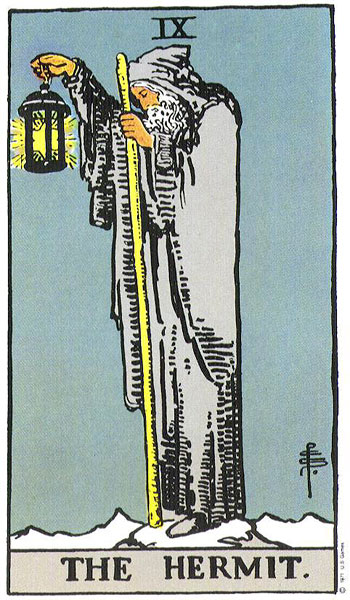
The High Priestess's introspection focuses on intuition and the reception of the subconscious, like a silent vessel; the Hermit, on the other hand, emphasizes actively seeking truth through the accumulation of experience, embodying the image of a lamp-bearing explorer.
In love divination, does the High Priestess always represent passivity?
Not passive, but emphasizing deep understanding and spiritual connection. She may suggest temporarily observing to identify core issues, or remind that relationships require soul-level resonance beyond appearances.