
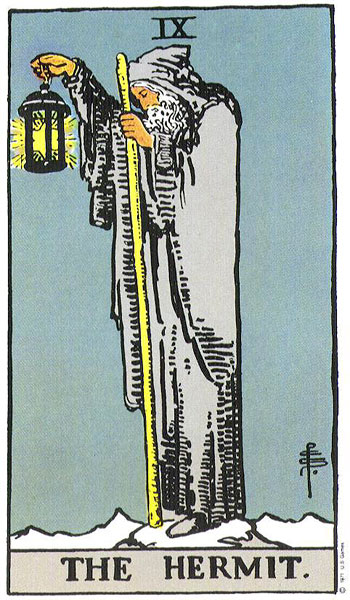
The Hermit
Upright Meaning
The upright Hermit represents a period of inward exploration and the search for truth. In love, singles may temporarily withdraw from social life, using solitude to clarify their true emotional needs rather than rushing into a relationship; those in a relationship require more spiritual communication or shared experiences of spiritual growth, but must also avoid neglecting their partner’s feelings due to excessive introspection. In career, this card suggests the need for independent work, in-depth research, or taking on an advisory role, making it suitable for fields requiring focus such as analysis, education, or scientific research; one may feel lonely in the workplace, but this is a necessary stage for accumulating professional wisdom. In health, it emphasizes the balance of body and mind, requiring attention to chronic issues or restoring energy through meditation and quiet recuperation; a reversed lifestyle (such as early sleep or fasting) may be beneficial. Overall, the Hermit encourages temporarily stepping back from the noise, gaining clear insights through self-reflection, and laying the foundation for future action.
Reversed Meaning
The reversed Hermit symbolizes avoidance of introspection, excessive isolation, or loss of direction. In love, it may manifest as self-seclusion due to fear of intimacy, or rejecting potential relationships due to excessive pickiness; those in relationships are prone to cold wars and lack effective communication. In career, it may involve refusing collaboration due to stubbornness, or causing plans to stall due to excessive procrastination; it can also indicate feeling lost in career exploration, unable to find a true calling. In health, be wary of depression, insomnia, or chronic fatigue triggered by loneliness, avoiding medical check-ups or ignoring bodily signals. On a spiritual level, the reversed Hermit may signify refusing to confront inner shadows, or indulging in empty philosophical musings without taking action. At this time, be cautious of self-deception—the lantern may illuminate the wrong path, or its light may be obscured by the self. It is advised to reassess the meaning of solitude, seek external guidance when appropriate, and avoid falling into a state of helpless isolation.
AI Deep Reading
A fresh reading of this card, written on the spot by AI.
Nothing is written until you ask — the reading is generated only when you tap the button.
History
The Hermit is the ninth card of the Major Arcana in tarot, with its history traceable back to 15th-century Italy, first appearing in the Visconti-Sforza tarot deck. Early depictions show an elderly figure holding an hourglass or lantern, symbolizing the passage of time and the light of wisdom. In the 18th-century Marseille tarot, the Hermit’s image became fixed as an old man draped in a cloak, carrying a lantern, standing alone on a mountaintop or in the snow, representing withdrawal from the world for cultivation and introspection. By the end of the 19th century, the Hermetic Order of the Golden Dawn and the Rider-Waite tarot further deepened its meaning, associating the Hermit with the astrological sign of Virgo, emphasizing analysis, caution, and spiritual pursuit. This card has always carried the archetype of the "solitary seeker" in the Western mystical tradition, echoing the wisdom-seeking paths of ancient Greek philosophers, Christian hermits, and Eastern ascetics.
Symbolism
The core symbolism of the Hermit card is inner exploration and the enlightenment of wisdom. In the image, the lantern held by the elder illuminates the path beneath his feet, symbolizing that the light of truth, though faint, is sufficient to guide the way; the lantern is often depicted in a six-pointed star shape, representing the balance between spirit and matter. He is draped in a gray cloak, signifying seclusion and humility, while the staff in his hand symbolizes support and authority. The snowy mountains or barren wilderness in the background suggest a solitary environment, yet also a realm of purity and transcendence. The overall tone of the card is dark, with only the lantern emitting light, emphasizing the philosophy of "seeking light in darkness." The Hermit's bowed head and contemplative posture echo the intuitive and introspective qualities of the element "Water," implying that true answers must be sought deep within the heart.
Advice
Temporarily step away from the noise and give yourself some alone time to listen to your inner voice. However, it is necessary to balance introspection with action: the lantern should not only illuminate thoughts but also guide practical steps. If you feel lost, seek advice from the wise or those with more experience, rather than relying entirely on self-exploration. Remember, solitude is for the sake of clarity upon return.
Related Cards
Frequently Asked Questions
Does the Hermit card always signify loneliness?
Loneliness is the path of the hermit, not the goal. It symbolizes voluntarily chosen solitude for the purpose of spiritual growth, rather than passive social isolation. The ultimate aim is to attain wisdom through self-reflection, thereby forging deeper connections with others and the world.
What is the connection between The Hermit card and Virgo?
In the Waite tradition, the Hermit corresponds to Virgo, sharing traits of analysis, caution, and service. Both emphasize the pursuit of perfection through meticulous introspection and purification, but the Hermit focuses more on spiritual exploration rather than handling practical affairs.