
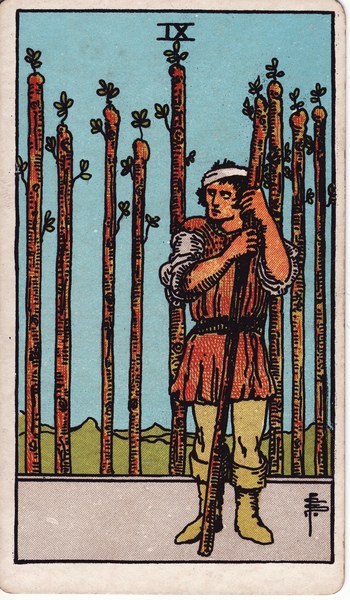
Nine of Wands
Upright Meaning
The upright Nine of Wands speaks for anyone still standing because they refused to sit down. Love belongs to partners who have weathered a real difficulty and now watch each other carefully, cautious rather than cold; new trust builds slowly here and is worth the patience it asks for. Professionally this is the card of the person who absorbed setbacks and kept the work alive, the survivor of a hard quarter, and it favours defending ground you already hold over opening a fresh front. Guidance: your wariness was earned, but ask whether the fence still protects something or has become the reason you never move.
Reversed Meaning
Reversed, the Nine of Wands shows the guard slipping. The same resilience has been spent past its limit, and what remains is fatigue rather than alertness. In relationships this may appear as snapping over small things after months of holding a larger strain, or a suspicion that has outgrown its evidence and started reading threat into ordinary behaviour. The last stretch of a long project looks like this: mistakes appear, tempers shorten and every request feels like one more than the person can carry; sharing the load, not more willpower, is the practical answer.
AI Deep Reading
A fresh reading of this card, written on the spot by AI.
Nothing is written until you ask — the reading is generated only when you tap the button.
History
Within the Golden Dawn's system the Nine of Wands carried the title Lord of Great Strength and the rule of the Moon in Sagittarius, a pairing of hardened experience with lingering unease. Earlier decks offered only nine plain staves, and Pamela Colman Smith introduced the wounded watchman in 1909: a figure with a bandaged head standing before a fence he has raised himself. Waite called it strength in readiness rather than strength in triumph, a soldier who keeps his post after the fighting.
Symbolism
The Nine of Wands is built out of what has already happened. Eight staves stand planted in the ground as a barrier the figure made himself, and he leans on the ninth as though it were a crutch; the bandage around his head says he has taken at least one blow. His posture is not aggressive. He looks back over his shoulder, which turns the card into a picture of guarded experience, caution bought at a price.
Advice
Hold your position, but check the cost of holding it. Take the rest you keep postponing, and let one trusted person carry part of the watch. Caution that never stands down stops being protection and becomes a second wound.
Related Cards
Frequently Asked Questions
Both the Nine of Wands and the Nine of Swords are about exhaustion; how do they differ?
The Nine of Wands leans toward exhaustion of body and will: its figure is wounded yet on guard, so its theme is endurance. The Nine of Swords works inside the mind, showing someone up in bed at night, face in hands, so its theme is anxiety and self-reproach. One holds a line; the other cannot quiet the mind.
In a yes-or-no reading, does the Nine of Wands lean yes or no?
It leans toward yes, but a difficult one. The Nine of Wands is neither a light confirmation nor a refusal; it says you can hold, while the cost is real. About continuing a direction or defending ground already won, it says yes. For starting something entirely new, it comes closer to: rest first, then ask again.