The Tower
Upright Meaning
The Tower upright represents sudden, unavoidable upheaval, the revelation of truth, and the shattering of old structures. In love, it may signal the eruption of hidden conflicts in a relationship (such as loss of trust or intense arguments), where long-suppressed issues force both parties to face reality. For singles, it can indicate a cognitive shift that breaks illusions about an ideal partner. In career, it often points to sudden workplace shocks (e.g., project failure, organizational restructuring, abrupt resignation). Though seemingly negative, such impacts expose systemic flaws and disrupt professional comfort zones, paving the way for growth aligned with true values. In health, it warns that long-neglected issues may manifest acutely (e.g., stress-induced breakdown), compelling you to radically change unhealthy habits or thought patterns. Overall, the destruction of the Tower carries liberation—it demolishes unstable "castles in the air," grounding you in reality. Though painful, this process is a necessary step toward awakening. The core meaning of the card is not the disaster itself, but the possibility of freedom and rebuilding through sudden change.
Reversed Meaning
The Reversed Tower signifies delayed, resisted, or internalized upheaval. It may manifest as: First, avoiding external collapse while persistently suppressing anxiety internally, leading to chronic depletion; Second, attempting to control inevitable change, resulting in prolonged impact or self-directed attacks (such as depression, self-doubt); Third, refusing to release old patterns after experiencing destruction, clinging to the wreckage. In love, it may involve avoiding fundamental issues in a relationship, masking cracks with surface harmony, or wallowing in pain after a breakup rather than embracing new beginnings. In career, it could mean staying in an unsuitable position out of fear of change, or passively resisting after restructuring, hindering necessary adaptation. In health, it often points to ignored physical and mental warnings, with minor issues accumulating into chronic illness. The Reversed Tower reminds us that resisting change only prolongs suffering, and that actively embracing inner release—sometimes voluntarily dismantling the tower—is wiser than waiting to be struck by lightning.
AI Deep Reading
A fresh reading of this card, written on the spot by AI.
Nothing is written until you ask — the reading is generated only when you tap the button.
History
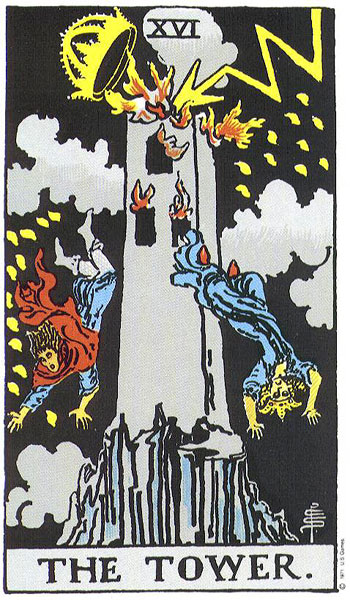
The Tower is the 16th card of the Major Arcana in tarot, with its history traceable to the 15th-century Visconti-Sforza tarot of Italy, where it was early known as the "House of Lightning" or "House of God." In the 17th-century Marseille tarot, its imagery became largely standardized: a tower struck by lightning, a crown falling from its top, and two figures plummeting from it. This card is deeply influenced by Christian culture, often seen as divine judgment against pride (the Tower of Babel) or rigid structures, symbolizing sudden collapse brought about by divine intervention. In the late 19th-century Rider-Waite tarot system, A.E. Waite and Pamela Colman Smith further reinforced its imagery of "upheaval" and "revelation," making it an iconic symbol of inevitable catastrophe within the tarot system.
Symbolism
The core symbolism of the Tower card is sudden upheaval and liberation. In the image, the tower represents a man-made system that appears stable but is detached from reality (such as rigid beliefs, power structures, or self-deception); the lightning bolt signifies an impact from a higher force (the universe, truth, or the subconscious), instantly shattering false stability; the falling crown implies the collapse of worldly power or the ego; the two figures falling to the left and right symbolize the forced separation and descent of consciousness and the subconscious, matter and spirit; the flames and dark background highlight purification through fire and chaos; the overall composition forms a powerful image of "destruction before creation," emphasizing that only by demolishing outdated frameworks can suppressed truth be set free.
Advice
Do not fear collapse. The appearance of the tower is the universe forcibly correcting a deviated path. Allow the old structures to disintegrate, even if they once gave you a sense of security. Breathe in the ruins, and see clearly what is real and what is illusion. The focus now is not on repair, but on release. Embrace chaos as the prelude to rebirth, maintain the bare minimum of self-care, and wait for the dust to settle before rebuilding on a more solid foundation.
Related Cards
Frequently Asked Questions
Is the Tower card necessarily a negative card?
Not exactly. Although the process is painful, the essence of the Tower is liberation and the emergence of truth. What it destroys is false stability, making room for genuine growth. In the long run, it often serves as a breakthrough turning point.
What is the difference between The Tower and Death cards?
Death represents an inevitable, cyclical end and transformation, a process that is usually gradual and predictable; the Tower symbolizes a sudden, shocking collapse, more accidental and impactful, emphasizing the fatal flaws of old structures.