
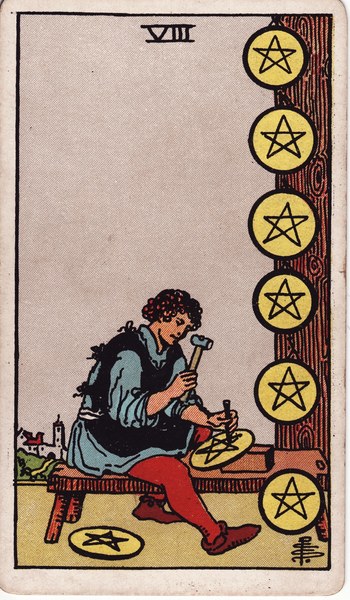
Eight of Pentacles
Upright Meaning
Eight of Pentacles is this suit's account of competence acquired the unglamorous way, one repetition at a time. At work it covers deliberate practice, training actually finished rather than merely started, and trades where mastery is counted in hours at the bench instead of flair. Money arrives here through skill, added gradually rather than in a lump, and the lesson underneath concerns attitude: a wage reflects what someone has become able to do. In love the card is quiet, showing devotion through small repeated acts. Its wider message is that excellence is a habit, not an event.
Reversed Meaning
Upside down the bench remains, but the work has stopped developing. It can look like corners cut and standards quietly lowered into mediocrity until nobody remembers what good was, or like its opposite: perfectionism, the coin polished forever and never handed over. In a working life it catches labour that has ceased to teach anything, and roles that consume hours without adding skill. Income turns erratic when the competence beneath it stalls. Inside a relationship the pattern is maintenance deferred, each partner assuming the other will keep things running. It asks whether you are practising or merely repeating.
AI Deep Reading
A fresh reading of this card, written on the spot by AI.
Nothing is written until you ask — the reading is generated only when you tap the button.
History
Numbered coins were commercial before they were pictorial. Marseille decks arranged eight discs in patterns with no figures, and medieval deniers passed among minters, guilds and merchants, so trade runs through the suit. The Golden Dawn called it the Lord of Prudence and placed it under the Sun in Virgo, the sign of method and routine. Waite and Smith broke with abstraction by drawing a person: an apprentice hammering a coin at his bench, seven finished pieces at the post behind him.
Symbolism
A young workman in a leather apron sits on a low bench, hammer raised, a chisel steadying the coin he is cutting. Seven pentacles hang in a column on the post beside him, the eighth still unfinished, so the scene records a process rather than a result. A small town climbs a hill behind him and nobody enters the workshop. There are no scales, no patron and no crowd. The coins are nailed up as evidence, not offered for sale.
Advice
Take the version of the task you can do slightly better than last time and finish it before starting another. Show your rough work to someone qualified to criticise it. Guard the daily hour that builds skill.
Related Cards
Frequently Asked Questions
Does the reversed Eight of Pentacles mean my effort has been wasted?
Not wasted, but stalled. Upright, repetition pays; reversed, it repeats without paying, so a task can run for months while the standard stays flat or quietly slips. Its other form is perfectionism, where work is revised endlessly and never delivered. The repair is the same: finish one piece and have it judged.
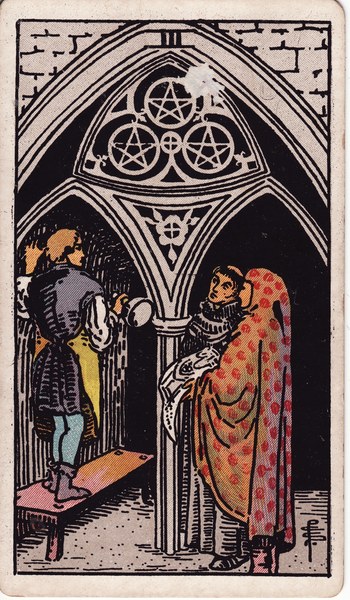
Both the Eight and the Three of Pentacles concern craftsmanship, so why does the Eight look so solitary?
The Three of Pentacles shows a division of labour: someone draws, someone builds, someone commissions, and the craft is acknowledged in public. The Eight has one apprentice, one hammer and the coins nailed to his post, so it describes the part nobody watches. One earns you credit, the other earns you the skill.