
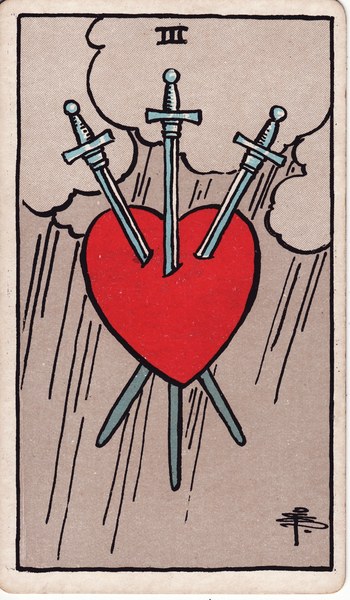
Three of Swords
Upright Meaning
Drawn upright, the pierced heart reports pain plainly rather than predicting disaster. In love it usually arrives at the moment of knowing: a betrayal confirmed, a rejection delivered, a long relationship ending, or the ordinary grief of watching someone change into a person you no longer recognise. Work has a quieter version, such as a project cancelled without warning or trust broken by a colleague's decision. It also covers sadness with no villain in it, the kind that shows up when a plan simply fails. Read the card as a state rather than a verdict: three swords can be drawn out, and the rain behind them is weather rather than climate.
Reversed Meaning
Turned, the swords begin coming out of the heart, so the reversal is read as the long middle of recovery rather than its happy ending. In love it can look like the return of appetite: laughing at something for the first time in weeks, or telling the story without flinching. At work it appears when a professional disappointment stops explaining everything and energy goes back into the work itself. Forgiveness belongs here too, usually aimed inward first, at yourself for staying or for not noticing. Nothing promises that whoever caused the hurt has changed, and nothing requires reconciliation: letting go is not the same act as making peace with them.
AI Deep Reading
A fresh reading of this card, written on the spot by AI.
Nothing is written until you ask — the reading is generated only when you tap the button.
History
In the older Italian and Spanish decks the three of swords was simply three curved blades in a decorative arrangement. Marseille printers kept that pattern, threading a flowering stem through the hilts. The pierced heart is Waite's addition, and it turned a numerical card into the deck's clearest image of grief. The Golden Dawn had already titled it Lord of Sorrow, under Saturn in Libra, a pairing of restriction and relationship that early readers took to mean sorrow produced by bonds.
Symbolism
Three blades pass through a red heart, which floats alone against a wall of grey cloud with rain falling in straight lines behind it. No person appears anywhere in the picture, and that absence carries much of the meaning: the card shows the wound rather than the wounded. The swords enter at different angles and stay stuck, so nothing suggests a clean removal. The rain keeps falling, and behind it there is no sun.
Advice
Give the sadness its actual size and do not rush to make it useful. The card is honest about damage and unhurried about repair: let this be a phase rather than an identity, and notice the moments when the rain stops being the first thing you see.
Related Cards
Frequently Asked Questions
Does drawing the Three of Swords mean a relationship is certain to end?
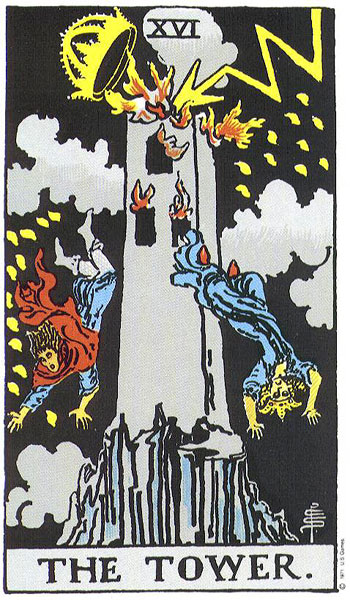
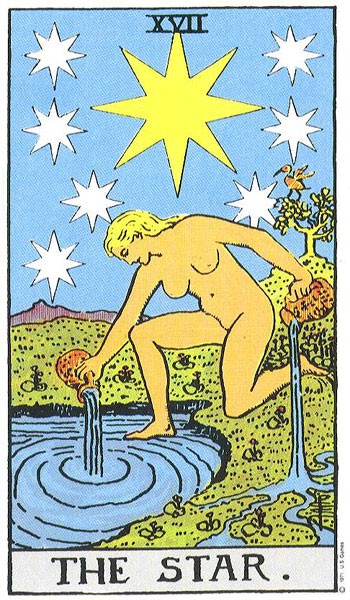
Not necessarily. It states that the pain is real, which is not the relationship being over. With closing imagery like the Tower or Death present, an ending is more likely; the Four of Swords, the Star or the Two of Cups instead points to a hard period of repair. This card alone rarely justifies a separation.
How long does the sadness of the Three of Swords usually last?
The imagery gives no timetable, but this is a card of process rather than a fixed state. Three blades entered together, so the damage is specific and can come out one at a time. In practice, watch for the reversal, or for the Four of Swords and the Star to appear; those mark the shift from enduring to recovering.