Death
Upright Meaning
The upright Death card represents the inevitable end of a chapter and the beginning of profound transformation, with its core being "letting go to be reborn." In love, it may signify the natural conclusion of a relationship, deep emotional change, or liberation from old patterns. This is not necessarily negative—it could be a necessary separation for mutual growth, or an opportunity to elevate the relationship to a deeper, more authentic level. For singles, it means completely letting go of past emotional baggage and embracing the future with a renewed mindset. In career/academics, it indicates the end of a work project, job changes, company restructuring, or even industry transformation. This may involve unemployment or major setbacks, but the card emphasizes that this clears the way for new opportunities more aligned with your life path. Voluntary resignation, retirement, or a complete career shift also fall under this. In health, it often points to a major turning point in physical or mental state, such as the end of an illness, the start of recovery, or the complete cessation of an unhealthy habit (e.g., smoking, staying up late). It reminds you that only by acknowledging and ending old depletion can you welcome true vitality. Overall, the upright Death card calls you to accept endings, stop resisting, understand this as part of the natural cycle, and trust that the new life to come will be all the more abundant.
Reversed Meaning
The reversed Death card represents resistance to change, stagnation, or an unfinished ending. Energy is blocked, and the individual may be deeply trapped in a situation that has already ended or should have ended long ago, refusing to let go due to fear, attachment, or inertia. In love, this may manifest as clinging to a lifeless relationship, being unable to move on from a breakup, or refusing to face fundamental issues in the relationship. In career, it could mean fearing to leave a job with no prospects, leading to developmental stagnation; or a project dragging on without closure, with change left half-finished. In health, the reversed Death warns of long-term neglect of warning signals from the body and refusal to change harmful habits, which may cause minor issues to worsen. Psychologically, it may involve dwelling on past trauma and being unable to let go. Alternatively, change may occur more suddenly, chaotically, or painfully, as prior resistance amplifies the impact of the ending. The reversed Death urges you to confront what has long been "dead" and to actively complete the process of letting go. It may also indicate that transformation is happening, but on a more hidden, internal level, or that you are slowly recovering from an extremely difficult ending. Regardless, the core lesson is to embrace acceptance and actively participate in the process of transformation.
AI Deep Reading
A fresh reading of this card, written on the spot by AI.
Nothing is written until you ask — the reading is generated only when you tap the button.
History
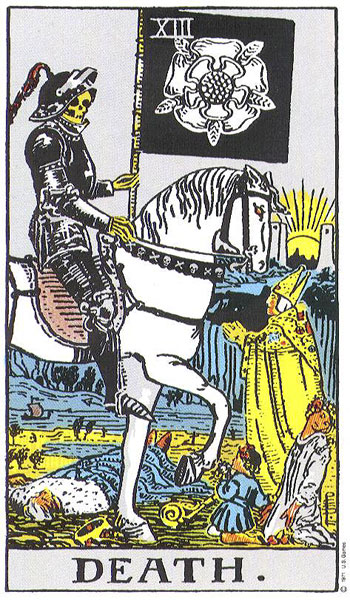
Death card number XIII is one of the most controversial and often misunderstood cards in the Major Arcana of the Tarot. Its history can be traced back to 15th-century Italy, where early depictions often featured skeletons or figures of Death, directly symbolizing the end of physical life. In the Marseille Tarot, Death is portrayed as a skeleton reaping lives, reflecting the widespread fear of plague and death in medieval Europe. However, during the occult revival led by figures such as A.E. Waite in the late 19th century, the interpretation of the Death card underwent a profound transformation. The Waite-Smith Tarot retained traditional imagery—such as the knight, the banner, and the fallen king—while incorporating a rising sun and twin pillars in the background, emphasizing the philosophy that "an ending is a new beginning." This elevated the card from a mere omen of death to a symbol of spiritual transformation and necessary closure. As a result, this card has become a central piece in the Tarot system for exploring themes of change, cycles, and rebirth.
Symbolism
The core symbolism of the Death card is "transformation." In the card, the Death knight, clad in black armor, represents the irresistible force of change; his white horse beneath him signifies vitality, indicating that transformation itself is full of energy. Between the rising sun and the two pillars in the background, it foreshadows new life after darkness. The fallen king, bishop, maiden, and child symbolize that worldly power, faith, innocence, and the future are all equal before change. The river represents the flow of life and the subconscious, while the boat sailing on it symbolizes the transition of the soul. The black rose pattern on the flag combines death (black) with passion (rose). The overall image does not depict physical death but rather symbolizes the complete end of old patterns, relationships, or phases, making way for a brand-new beginning, emphasizing the cosmic law of "no destruction, no construction."
Advice
Bravely accept this ending. Do not resist change, even if it brings temporary pain or loss. Consciously let go of people, things, or habits that no longer serve your highest good. Mourning the loss is necessary, but do not dwell in it. Clear the space, whether physically or emotionally. Trust that this ending is part of life's natural cycle, paving the way for your necessary rebirth. Look ahead, a new sun is rising.
Related Cards
Frequently Asked Questions
Does drawing the Death card mean physical death?
Almost never. In the vast majority of modern Tarot interpretations, the Death card symbolizes metaphorical "death"—the end and transformation of a state, relationship, habit, or phase of life. It concerns significant psychological, spiritual, or situational changes, not physical demise.
Upright Death and Reversed Death, which one is "worse"?
Tarot cards are not simply judged as "good" or "bad." The upright Death card, though confronting endings, has smooth energy, foretelling rebirth after a complete transformation. The reversed Death card, on the other hand, often indicates stagnation, delay, or a more chaotic ending process caused by resistance, which may prolong suffering. Therefore, the reversed position often suggests a psychological state that requires greater vigilance.