
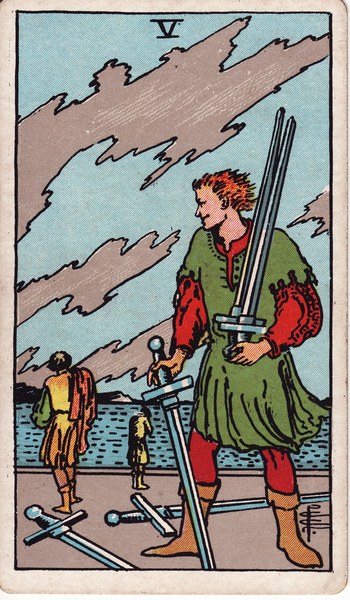
Five of Swords
Upright Meaning
This is the suit's picture of a contest settled at a price nobody wanted to pay. In love it shows an argument won by whoever argued harder, with a longer silence as the prize; in a family or a group of friends it can mean one person's standing defended by making somebody else small. Work readings bring competitive environments where the loser keeps working beside the winner, or credit taken by someone who did not do the work. The card rarely predicts defeat for everyone; it warns that the available win is hollow. Look at the cost before pressing an advantage, and notice when fighting has become its own reason.
Reversed Meaning
The quarrel is allowed to end rather than be won. In love this appears as the exhaustion that finally makes a truce possible: an old argument set down, an apology offered without conditions, or the decision that being right is not worth another month of this. Professionally it reads as stepping out of a competition whose rules were never defined, which often coincides with leaving a workplace where scoring had replaced the work itself. It can also describe the awkward stretch after a conflict, when people still carry a grudge in one hand. End things properly: say what happened, stop keeping score, and accept that the record will not be settled to your satisfaction.
AI Deep Reading
A fresh reading of this card, written on the spot by AI.
Nothing is written until you ask — the reading is generated only when you tap the button.
History
Five of Swords takes its title from the Golden Dawn's placement on the Tree of Life, where it was called the Lord of Defeat under Mars in Aquarius. Earlier engraved decks showed five blades in decorative symmetry with nobody in the frame, so the quarrel itself is a nineteenth-century invention. Waite added a figure gathering swords while others walk away, which gave the suit its sharpest comment on winning. That scene, not the title, is what modern readers describe.
Symbolism
In the foreground a man gathers swords into his arms, three hilts visible, and looks back over his shoulder with a faint smile. Two more swords lie flat on the ground, unattended. Behind him two figures walk away, heads down, toward a strip of water under a ragged sky. The blades he holds have no obvious owner, and nothing in the scene is worth having won. Nobody in the background is running.
Advice
Ask what the fight is actually for, then subtract the price of winning it. If the answer is nothing you would still want afterwards, stop pressing. If you were the one beaten, refusing to re-litigate is strategy, not surrender.
Related Cards
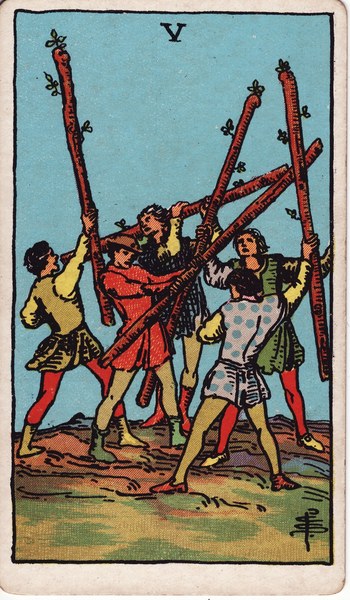
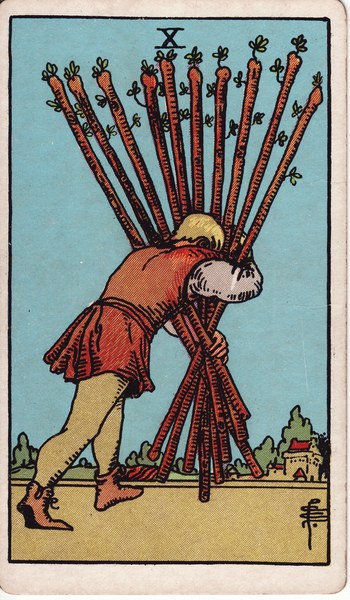
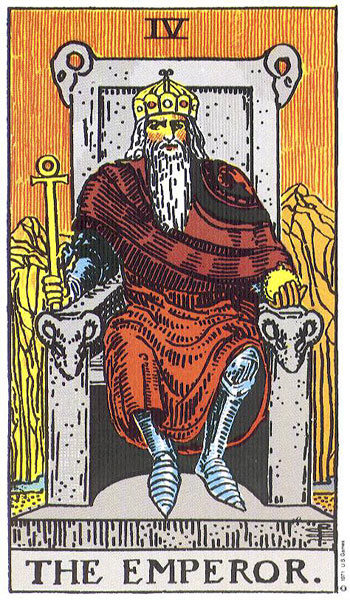
Frequently Asked Questions
Does the Five of Swords mean I am going to lose?
It says more about the contest than about the outcome. The winner in the image holds three swords and has gained nothing worth keeping, which is why the card warns against entering a fight whose rules were never defined. If a defeat has already happened, it points to cutting the loss rather than salvaging pride.
With the Five of Swords in a career reading, should I consider leaving the team?
Decide first whether the card is a warning or a conclusion. Alongside the Eight of Swords, the Eight of Wands or the Tower, leaving gains weight; alone, it asks you to deal with the quarrel at hand by shifting the goal from winning to finishing the job. Whether the conflict is occasional or structural is your call.