
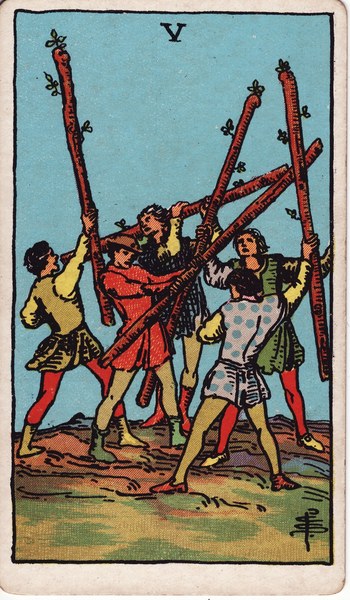
Five of Wands
Upright Meaning
Competition arrives here in its everyday form. Love readings catch the friction of people negotiating for the same attention: bickering that restates an argument instead of resolving it, a household where chores or in-laws have become a tournament, several admirers circling one person. At work it describes a genuinely crowded field, such as a role with many qualified applicants, a department defending its territory, or teammates whose incentives point in different directions. Guidance rests on scale: sparring can sharpen everyone involved, so the useful question is whether this contest has rules and a finish line, or is only heat without structure.
Reversed Meaning
Upside down, the scuffle goes quiet in the worst way. Conflict is avoided rather than settled, so it returns as politeness with an edge, passive aggression, or a decision nobody will make. Romantic readings can show two people agreeing in public and keeping score in private. Careers suffer when rivalry is exported or hidden: internal competition that eats a team from within, a player who cannot lose gracefully, an atmosphere so combative that nobody proposes anything risky. Excessive competition is its own failure, because when everyone fights to be seen the actual work stops.
AI Deep Reading
A fresh reading of this card, written on the spot by AI.
Nothing is written until you ask — the reading is generated only when you tap the button.
History
This card's meaning was once carried by its number alone: older divinatory systems read five batons as quarrels, lawsuits and rivalry over a single prize, an interpretation lifted almost directly from a hand with five fingers grabbing at once. The Golden Dawn placed it under Saturn in Leo and named it the Lord of Strife. Pamela Colman Smith's young men look like they are rehearsing rather than injuring one another. That choice keeps the card about friction rather than injury.
Symbolism
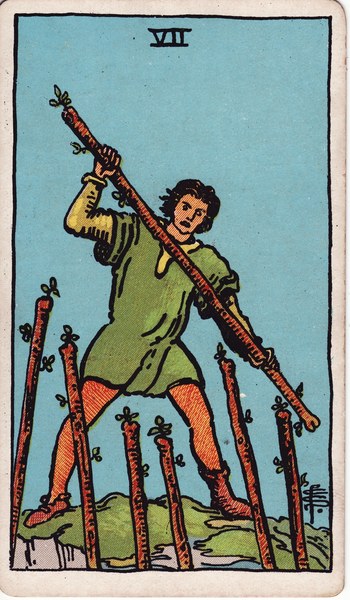
Five figures each grip a wand, and every wand is accounted for, so this is a scramble for position rather than a battle with casualties. No blood, no fallen body, no identifiable winner: friction itself is the subject. Mismatched civilian clothing makes the struggle ordinary, and all five stand on level ground, the advantage the Seven of Wands later grants to one side. Nothing in the scene has been settled.
Advice
Decide whether this is a game or a real fight, then act accordingly. If there are rules and a prize worth having, sharpen up and compete; if there is neither, restructure the situation instead of winning an argument that repeats next week.
Related Cards
Frequently Asked Questions
Can the quarrelling in the Five of Wands escalate into a breakup or real harm?
The image carries no blood and no fallen figure, so it points to friction that can be contained rather than a rupture. The test is whether both sides still argue inside shared rules: while the dispute stays about the matter itself it is adjustment, but once it turns personal, Swords cards signal a change of character.
Both involve conflict, so how do the Five of Wands and the Five of Swords differ?
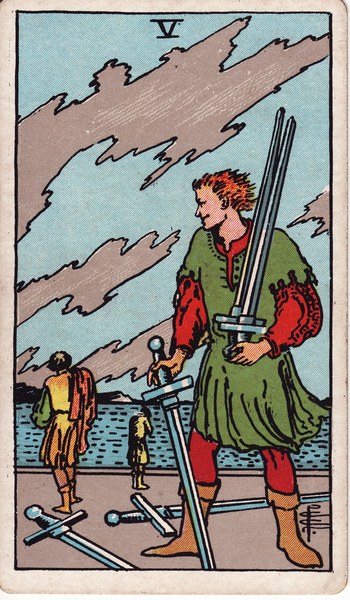
The Five of Wands is a scramble on level ground where nobody holds an advantage and nobody is truly defeated, so the friction is heated but rarely malicious. The Five of Swords is winner-takes-all with a humiliated loser, and its subject is winning the argument while losing the relationship.