
Four of Pentacles
Upright Meaning
Security hardening into rigidity is the lesson here. In money and work it appears as prudent caution that has turned into refusal: savings nobody will ever spend, a business that will not hire because hiring costs money, a post kept for the pension while the skills go stale. The card does not condemn thrift, it asks whether the grip still serves anything. In relationships the same posture reads as guardedness, a partner who offers stability but keeps one hand on the exit, or someone who equates control with care. The useful question is what is being protected, and who is being kept out.
Reversed Meaning
Once the arms unfold, the result can go either way. One version is release: a person finally spends on something that matters, shares what they had been hoarding, or drops a defensive posture and lets a relationship count for more than the terms. The other version is the same motion without the wisdom, the saver who becomes a spender, an account emptied to feel free for a fortnight, generosity performed to avoid a conversation. Either way the card describes loosening. The judgement is whether what leaves your hands is a decision or a reaction.
AI Deep Reading
A fresh reading of this card, written on the spot by AI.
Nothing is written until you ask — the reading is generated only when you tap the button.
History
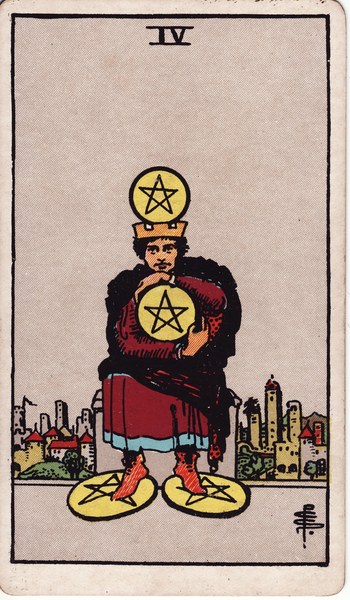
The Four of Coins began as a plain square of four discs inside a decorative frame, and readers took it at face value for centuries: money kept, money held back, a fortune guarded by someone unwilling to move it. The Golden Dawn gave the decan Sun in Capricorn the title Lord of Earthly Power, an odd pairing that captures the card's tension, a strong warm planet working through the sign of restraint. Waite and Smith replaced the frame with a body clutching what it owns.
Symbolism
The pose is the reading. One coin is clutched against the chest, closest to the heart, while the other three are folded into his own body: one worn as a crown, two crushed underfoot. He cannot use any of them without moving, and moving is what he has stopped doing. Behind him stands the city he presumably governs, so the hoard is guarded at the cost of the community it could reach. He sits low and outside the walls: a ruler on the street, counting.
Advice
Ask what the holding is for. Name the fear underneath the refusal to spend, the unwillingness to share, the terms you keep setting, then test it with one small deliberate act of movement: a single payment, a disclosure, one honest sentence.
Related Cards
Frequently Asked Questions
Both the Four of Pentacles and the Devil involve attachment, so how do I tell them apart?
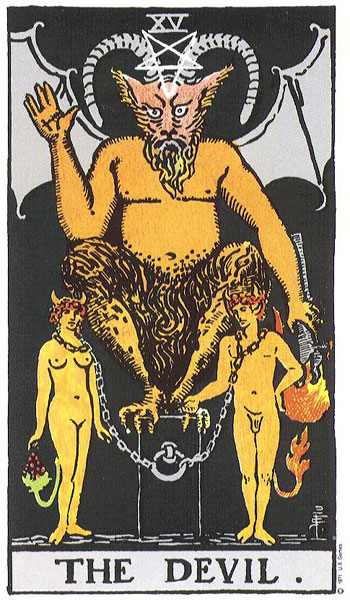
The Devil describes compulsion and self-betrayal, where a person often sees the chain clearly and still cannot leave, and the grip shames as much as it binds. The Four of Pentacles is simpler: a closed fist driven by scarcity, usually with room to loosen. One calls for a break, the other asks you to open your hand.
Is the Four of Pentacles good or bad when I ask about saving money or buying a house?
For saving and property questions it leans favourable, describing someone who holds on, does not move impulsively and lives inside their means. The caution is about proportion, not the behaviour. If the saving is paid for with health, relationships or opportunities, the card points at rigidity instead of prudence.