
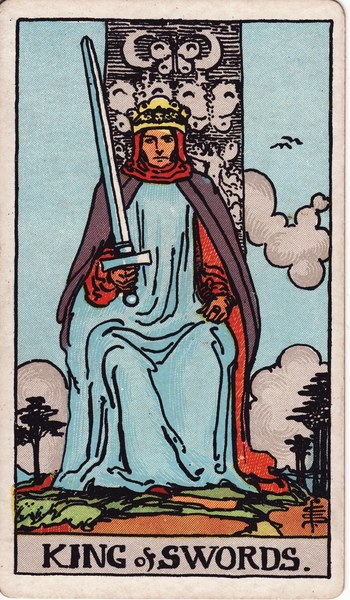
King of Swords
Upright Meaning
Judgement made with authority and applied consistently defines the King of Swords. In love he describes a partner or a phase defined by integrity rather than intensity: someone who keeps their word, discusses problems as problems and prefers a clear agreement to a long ambiguity, including, when it comes to it, a fair and unbitter separation. The card often appears when a relationship needs a rule rather than another feeling. At work it points to expertise others defer to, the senior colleague, mentor or auditor whose opinion settles a matter, and to the ability to bring that standard to your own decisions.
Reversed Meaning
With the King of Swords reversed, the authority remains and the fairness goes. In love the card shows rules imposed rather than agreed, one person deciding what is reasonable for both, logic used to close down a discussion, or verdicts delivered where a conversation was needed. It can also describe a relationship run like a court, in which every disagreement becomes a case to be won. At work, the reversed king warns about the manager who treats process as a weapon, the expert whose confidence has outrun the evidence, and the selective use of rules against people who are not favoured.
AI Deep Reading
A fresh reading of this card, written on the spot by AI.
Nothing is written until you ask — the reading is generated only when you tap the button.
History
As the senior figure of the Air court, the King of Swords descends from the enthroned king of the fifteenth-century Italian suits, where rulers were distinguished by rank and symbol, not character. The Golden Dawn read the court through the elements, making each king the fire aspect of his suit, so for Swords he is the will that puts reason into effect and the card concerns judgement rather than opinion. Pamela Colman Smith drew him in 1909 seated frontally, sword upright, gaze straight ahead.
Symbolism
The king faces the viewer squarely instead of turning aside, so his judgement is presented as open and answerable. His sword stands nearly upright, meaning the reasoning is settled. The butterflies carved into the stone throne make the suit's element visible: the mind's own transformation, and the reason this king can revise a ruling. Crown and blue robe place him in the institutions of law and learning, not on a battlefield.
Advice
Decide on a principle you would state out loud, and say what it means in practice. Put the reasoning in writing where others can test it, and give the person affected a real chance to answer. Authority here is held by explanation, not volume.
Related Cards
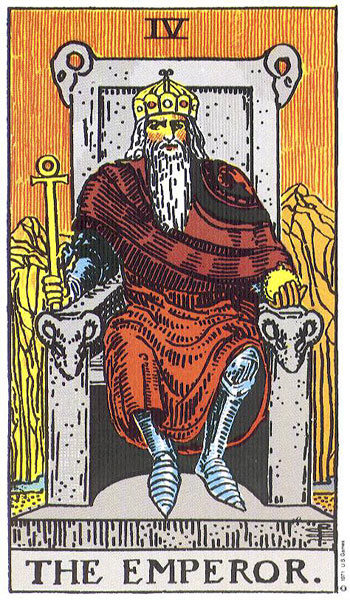
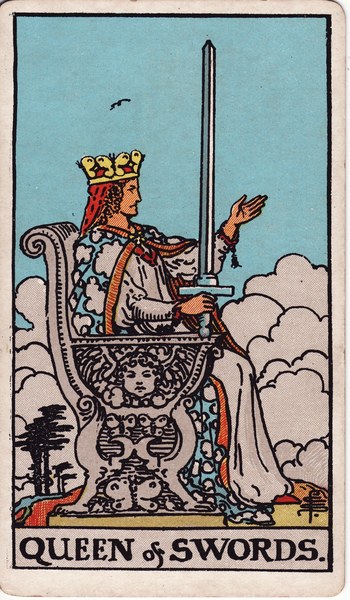
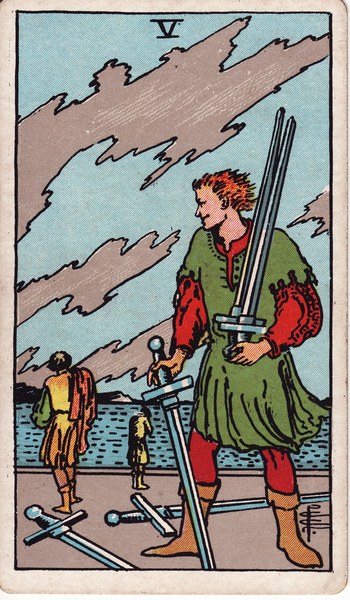
Frequently Asked Questions
The King of Swords and the Emperor both signify authority. Where is the difference?
The Emperor stands for institutional power and long-term governance, operating through structure and rules, and answers who is in charge. The King of Swords stands for authority earned through reasoning and evidence, where the ruling stays open to discussion, and asks whether the reasoning holds up.
How should I read the King of Swords for a career question or one about a contract?
It usually points to a situation that needs clear wording and solid grounds: terms read line by line, reasons kept on record, and disagreements set out in writing. It may also represent an experienced superior, adviser or professional who values facts, whose opinion frequently settles the matter at hand.